
A variable dynamic vibration absorber that self-adjusts its vibration absorption frequency based on gait patterns, ensuring high data quality for cameras and inertial sensors and maintaining the accuracy of the robot's localization.
Background and Necessity of the Invention
Legged mobile robots, including quadrupedal robots, are rapidly becoming essential workers in industrial settings. Capable of navigating stairs and rough terrain that are difficult for wheeled robots, and entering disaster zones or industrial plants that are hazardous for humans, their range of applications is expanding quickly—from inspecting power plants and oil facilities to construction site monitoring, security patrols, disaster rescue, and logistics. Market research firms project that the quadrupedal robot market will grow at an average annual rate of around 18% over the next decade, with the number of commercial units increasing from approximately 18,000 in 2025 to over 90,000 by the mid-2030s. The core driver of this growth is "autonomy," which allows robots to find their own paths and perform tasks without constant human intervention.
The starting point for autonomous navigation is localization, where the robot accurately determines its current position. This widely utilizes Visual-Inertial Odometry (VIO) and SLAM (Simultaneous Localization and Mapping), which combine camera data (visual information) and Inertial Measurement Units (IMU). These two sensors complement each other's weaknesses and are cost-effective and lightweight, making them ideal for integration into robots. Ultimately, the quality of the data provided by these camera and inertial sensors determines the accuracy of the robot's localization, and by extension, the reliability and safety of its autonomous navigation.
The challenge lies in the fact that the gait of a legged robot inherently involves periodic impacts, vertical oscillations, and sudden rotations as the legs strike the ground. Recent robotics research identifies these "foot-contact impacts" and "high-frequency vibrations" as major obstacles that disrupt standard perception systems. When these vibrations are transmitted directly to the camera and inertial sensors, motion blur occurs in the video, causing errors in feature point extraction and tracking—the keys to localization. In severe cases, the trajectory estimation of VIO and SLAM can collapse entirely. The paradox is that the faster and more powerfully a robot moves, the more its "eyes" become blurred, which hinders autonomous navigation.
Previously, rubber dampers or nylon rings used in drones were attached to sensor platforms to reduce vibration. However, because these components have fixed characteristics, they cannot adapt to changing gait patterns, which can sometimes lead to resonance and increased shaking of the sensor platform. Furthermore, while soft dampers are effective for vibration absorption, they suffer from the dilemma of deforming excessively under large impacts or sudden movements. Therefore, an active shock-absorbing and vibration-damping structure was needed—one that can autonomously change its absorption characteristics whenever the walking speed or pattern changes.
Technical Principles and Implementation Methods
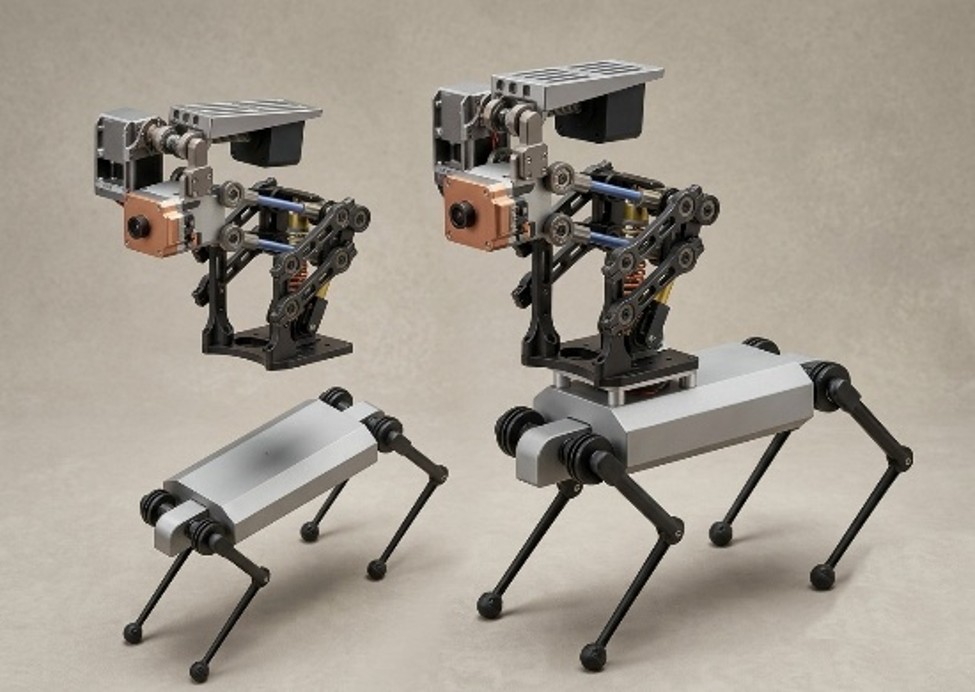
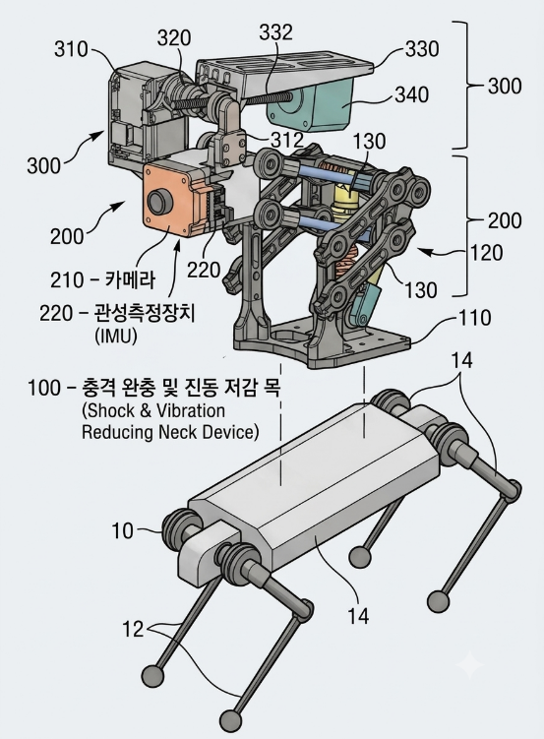
Much like how animals use their necks to stabilize their heads and eyes while running, this invention places a "neck" device between the robot's body and its sensors to filter out vibrations. The device consists of three main parts: a shock absorber that provides primary impact absorption, a sensor platform that holds the camera and inertial sensors, and a variable dynamic vibration absorber that adjusts the absorption frequency to match the gait-induced vibrations.
The shock absorber consists of a mounting plate fixed to the robot's body and a plurality of linkages connected by various joints and rods. Each linkage incorporates a hydraulic damper and a spring, which work together to absorb impacts and vibrations from the body, reducing the amount transmitted to the sensor platform. This stage acts as the first line of defense against sudden impacts.
The sensor platform is mounted on top of the shock absorber and carries the camera and inertial measurement unit, facing forward. The ultimate goal of this invention is to minimize the positional displacement and rotation of this platform. The stability of the platform directly dictates the quality of the sensor data and the accuracy of the localization.
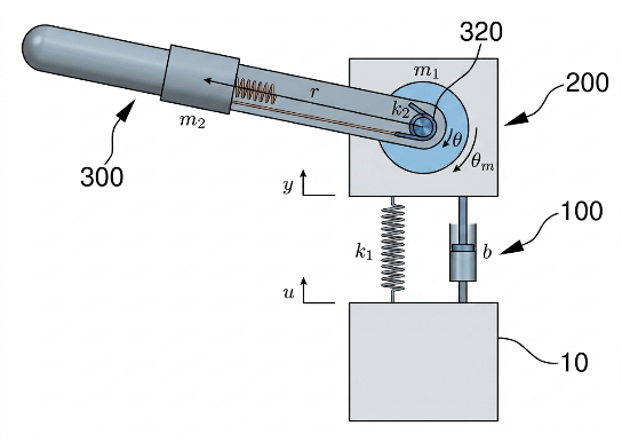
The core component is the variable dynamic vibration absorber mounted on the sensor platform. A dynamic vibration absorber is a classic device that uses a separate mass to oscillate and cancel out the vibrations of the main body; this invention adds an "adjustment function" to that concept. An actuator rotates a torsion spring, and a linear stepping motor (acting as the mass) moves back and forth along a guide connected to the spring. This allows the distance of the mass from the center of rotation to be actively changed.
Dynamically, the "absorption frequency" at which this device cancels out vibration is determined by the distance of the mass; the closer the mass is to the center of rotation, the higher the frequency it absorbs. Therefore, when the robot walks faster and vibrations increase, the mass can be moved closer, and when it walks slowly, it can be moved further away, allowing the absorption frequency to be tuned in real-time. This ensures that the movement of the sensor platform is stably suppressed even as walking speeds and patterns change.
Technology Advantages and Expected Effects
Technology Advantages The greatest strength is its actively adjustable "variability." Conventional tuned mass dampers (TMDs) have fixed absorption frequencies, meaning their effectiveness drops sharply when the vibration frequency changes. Passive dampers with fixed characteristics are known to perform well only when the disturbance frequency is constant; however, legged robots experience constantly changing vibration frequencies as they walk, run, or change direction. This device adjusts the absorption frequency in real-time by shifting the position of the mass, allowing it to avoid resonance and obtain stable visual and inertial data even as speed and patterns change. Furthermore, because this re-tuning is performed with minimal power, it places less of an energy burden on the system compared to active control methods that require constant high force.
This represents a fundamentally different approach from existing vibration reduction methods. Vibration control is typically divided into "passive" types with fixed characteristics and "active" types that require constant high driving force. Passive systems are limited to specific frequencies, while active systems are energy-intensive and structurally complex. This device occupies the middle ground as a "variable (adaptive)" system that re-tunes the absorption frequency simply by shifting the mass, capturing the benefits of both. By using simple mechanisms—a torsion spring and a linear stepping motor—rather than expensive, specialized vibration-absorbing components or complex active controls, it achieves both high performance and cost-effectiveness across a wide frequency band.
Applications This technology can be used in any mission requiring clear visual information despite motion. Key applications include unmanned inspections of hazardous or hard-to-reach sites such as power plants, oil refineries, and electrical substations, as well as monitoring in mining and construction, patrol and security, and disaster relief and rescue operations. These are all tasks where robots must act as human eyes in environments inaccessible to people. In fact, industrial inspection accounts for the largest share of the quadruped robot market, and commercial use cases—such as explosion-proof inspection robots deployed in oil and energy facilities—are growing rapidly. Furthermore, there is broad potential for application across mobile platforms that carry cameras and inertial sensors, including autonomous mobile robots, drones, and wearable filming equipment.
Increased stability in sensor data improves the accuracy of localization and SLAM (Simultaneous Localization and Mapping), which in turn enhances the reliability and safety of the robot's "autonomy"—its ability to navigate and perform tasks without human intervention. Since unstable localization increases the risk of a robot veering off course or falling, this technology, which fundamentally filters out vibration, becomes a key factor in the reliability of autonomous navigation. Additionally, because it is implemented using affordable components rather than expensive, specialized parts, it is expected to lower production costs and contribute to accelerating the commercialization and widespread adoption of legged robots.
Patent Listing IBL-26-0841
Inventors: Professor Dongjun Lee and Taekyun Kim, Department of Mechanical Engineering, Seoul National University



