
A cathode active material manufacturing technology that evenly loads sulfur into microscopic pores created by dissolving cobalt, while using the remaining cobalt sulfide to trap polysulfides, thereby enhancing both the conductivity and lifespan of lithium-sulfur batteries.

Background and Necessity of the Invention
As the use of electric vehicles and energy storage systems grows rapidly, there is an increasing demand for next-generation batteries that are lighter and hold more energy than current lithium-ion batteries. A leading candidate is the lithium-sulfur battery, which uses sulfur for the cathode and lithium metal for the anode. Sulfur is an inexpensive raw material produced in large quantities during oil refining, and it does not require expensive metals like nickel or cobalt. Its energy density per unit weight is more than 1.5 times higher than that of existing lithium-ion batteries, making it particularly attractive for unmanned aerial vehicles, drones, and urban air mobility (UAM) applications where weight is a critical performance factor.
The market outlook is also bright. Market research firms predict that the global lithium-sulfur battery market will maintain a high average annual growth rate of around 30% from 2026 to 2035, citing demand from aerospace, defense, and advanced mobility as key growth drivers. In South Korea, a high-altitude solar-powered unmanned aerial vehicle equipped with lithium-sulfur batteries has already completed a flight test in the stratosphere lasting approximately 13 hours, and commercialization efforts are underway with the goal of integration into urban air mobility and high-altitude drones.
However, a long-standing challenge remains in the path to commercialization. First, sulfur is an electrical insulator, so it must be combined with highly conductive materials like carbon. A greater problem is lithium polysulfide, an intermediate substance generated during the charge and discharge process. This substance dissolves in the electrolyte and moves between the cathode and anode, causing a "shuttle" effect. This leads to the loss of sulfur needed for reactions, resulting in reduced capacity and a shorter lifespan.
To solve this, research has focused on loading sulfur into porous carbon, but the process of creating the desired pore structure is complex, and the amount of sulfur that can be loaded is limited by the shape and size of the pores. Attempts to trap polysulfides using metal compounds have also been made, but it has been difficult to achieve both porosity and adsorption functionality simultaneously. Therefore, a method was needed to create a cathode material that can load a large, uniform amount of sulfur, conduct electricity well, and trap polysulfides that attempt to dissolve, all through a streamlined process.
Technical Principles and Implementation Methods
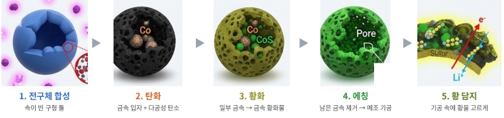
The cathode material created by this invention can be compared to a "magnet-embedded sponge ball." The conductive carbon forms a porous, ball-shaped skeleton like a sponge, sulfur fills the pores evenly, and cobalt sulfide particles embedded throughout act like magnets to attract and trap polysulfides. This structure is created through five sequential steps.
In the first step, a solution containing a dissolved cobalt compound is mixed with a solution containing an organic compound to synthesize a crystal (metal-organic framework) where metal and organic matter are interwoven like a net. When a methanol solvent and sulfate ions are present, the process of the crystal dissolving and regrowing repeats, spontaneously creating a hollow, porous, ball-shaped structure. Compared to precursors made in plate or polyhedral shapes under different conditions, the volume of large pores is approximately twice as large.
Next, the precursor undergoes a carbonization step, where it is heated to a high temperature in an inert gas such as argon. This transforms the organic matter into a porous carbon skeleton, and the cobalt forms metal particles ranging from a few nanometers to tens of nanometers in size. At this stage, the catalytic action of the cobalt causes some of the carbon to transform into an orderly, graphite-like structure, increasing the electrical conductivity of the skeleton.
In the third sulfurization step, the material is heat-treated in a furnace with flowing sulfur vapor, converting only a portion of the cobalt particles into cobalt sulfide. The subsequent fourth etching step is the core of this invention. When immersed in dilute hydrochloric acid, only the cobalt that has not been converted to sulfur is selectively dissolved, leaving behind the acid-resistant cobalt sulfide. Just as removing scaffolding after a building is finished creates empty space, the areas where the cobalt was removed become mesopores ranging from a few nanometers to tens of nanometers in size. This simultaneously provides space to load sulfur and sites to trap polysulfides.
Finally, the structure is mixed with sulfur powder, sealed, and heated to the melting point of sulfur. The molten sulfur permeates into the pores through capillary action, settling evenly. In the completed cathode active material, sulfur accounts for 60–75% of the total weight. The sulfur, evenly dispersed within the pores, exchanges electrons through the carbon skeleton, while the adjacent cobalt sulfide traps any polysulfides attempting to dissolve.
Advantages and Expected Effects of the Technology
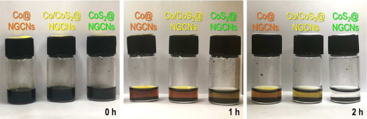
Advantages of the Technology The greatest strength is that three distinct roles are clearly divided within a single material. The graphitized carbon skeleton serves as a pathway for electrons, the mesopores created by dissolving cobalt break down the insulating sulfur to ensure it is evenly distributed and participates effectively in reactions, and the remaining cobalt sulfide traps polysulfides to suppress the shuttle effect. In fact, when the material was placed in a solution containing dissolved polysulfides, the solution became nearly transparent within just two hours. Electrodes made with this material maintained a capacity of approximately 900 mAh per gram after 100 charge-discharge cycles, and about 500 mAh even after 300 cycles at high speeds.
This approach differs from existing methods in both sequence and concept. Methods that attach metal sulfides to porous carbon can face issues where the sulfide expands in volume, blocking the pores and preventing sulfur from spreading evenly; in fact, comparative materials where both cobalt and cobalt sulfide remained showed a rapid decline in capacity. This technology uses a step-by-step design that "sulfurizes only a portion of the metal and dissolves the rest," simultaneously securing both the catalyst to trap polysulfides and the pores to hold sulfur within a single workflow. The pore structure is created by the precursor itself, and the subsequent processes—heat treatment and acid treatment—are widely used methods, making the technology advantageous in terms of reproducibility and scalability.
Applications The most direct application is as a cathode material for lithium-sulfur batteries, where energy per unit weight is critical. Representative examples include high-altitude unmanned aerial vehicles that fly for long periods in the stratosphere, drones where flight time is a competitive advantage, urban air mobility vehicles, and defense or space equipment requiring lightweight power sources. In the long term, this can be expanded to electric vehicles and energy storage systems. It can be adopted as a functional cathode material by cathode and battery manufacturers, and there is also room for application in related materials such as separator coatings. Since the same technology is patented in Japan and the United States, it is also well-positioned for international commercialization.
Since the key to commercializing lithium-sulfur batteries lies in preventing the degradation caused by polysulfides, this technology, which suppresses the shuttle effect at the material level, could serve as a foundation for accelerating commercialization. Furthermore, as the use of batteries based on abundant and inexpensive sulfur increases, reliance on costly metals like nickel and cobalt, as well as supply chain pressures, can be reduced. Lighter and longer-lasting power sources are also expected to contribute to extending the flight times of drones and air mobility vehicles.
Patent Listing IBL-26-2009
Inventors: Professor Dong-Wan Kim and Seung-Deok Seo, Department of Civil, Environmental and Architectural Engineering, Korea University



