
A high-capacity cathode active material with a non-rock-salt layered structure that stabilizes oxygen reactions and reduces voltage decay and structural changes during charge and discharge cycles by incorporating more lithium than available sites, placing it in both octahedral and tetrahedral positions.

Background and Necessity of the Invention
Cathode materials are the core component determining how much energy a battery can store and at what voltage it is discharged; they also account for the largest share (around 40%) of cell material costs. However, the two currently dominant materials have distinct limitations. Nickel-rich ternary cathodes offer high energy density but rely on expensive metals like nickel and cobalt, while lithium iron phosphate (LFP) cathodes are affordable and safe but have lower energy storage capacity.
Lithium-rich (Lithium-Manganese-Rich, LMR) cathode materials have emerged as a promising alternative to bridge this gap. By increasing the lithium content, both transition metals and oxygen participate in charge-discharge reactions, resulting in higher capacity and lower costs by using inexpensive manganese as the primary raw material. US automakers and domestic battery companies have announced plans to mass-produce these batteries for electric trucks and large SUVs starting in 2028, noting that they offer approximately 33% higher energy density than LFP batteries at the same cost. Domestic cathode manufacturers are also accelerating commercialization efforts, including pilot production.
However, there is a reason why this material has been slow to commercialize despite decades of attention. Conventional lithium-rich cathodes are structured by inserting excess lithium into the transition metal layer to fill the available sites. While the oxygen surrounded by lithium releases additional electrons to create high capacity, the oxygen becomes unstable when lithium is removed during charging, causing some to escape as gas and leading to structural changes as transition metals migrate into the vacancies. This results in "voltage decay"—a drop in average voltage—and capacity loss over repeated charge-discharge cycles.
Attempts to prevent this by coating particle surfaces or adding other elements have improved performance to some extent, but the root of the problem lies in the atomic structure itself. Therefore, a new cathode material with an atomic arrangement that remains stable even when large amounts of lithium move in and out, while retaining the extra capacity provided by oxygen, was needed.
Technical Principles and Implementation Methods
A layered cathode material can be compared to a "stacked shelf" where lithium layers and transition metal layers alternate. Atoms sit in designated slots surrounded by six oxygen atoms, known as octahedral sites. Conventional lithium-rich materials fill the transition metal layer slots with excess lithium to match the number of slots and atoms. This invention takes a different approach: it intentionally incorporates more lithium than there are slots while maintaining electrical balance (charge neutrality).
So, where does the excess lithium go? It occupies smaller gaps surrounded by four oxygen atoms—the tetrahedral sites between the lithium and transition metal layers. As excess lithium is distributed between octahedral and tetrahedral sites, and some atoms between the two layers intermix, a "non-rock-salt" layered structure is formed, distinct from the conventional rock-salt structure. It is designed with the chemical formula Li1+x+yM1-yO2, with the amount of lithium in each site adjusted accordingly.
The lithium in these tetrahedral sites plays a key role. By altering the atomic arrangement around the oxygen, it creates a new, stable oxygen state and acts as a structural support, preventing transition metals from migrating into vacancies when large amounts of lithium are removed. This allows for the retention of the extra capacity provided by oxygen while reducing the oxygen gas release and structural changes that plagued previous materials.
This structure has been confirmed through actual analysis. Observations using an electron microscope capable of viewing individual atoms revealed that the transition metal layers contain significant amounts of lithium, with regions where atoms are arranged more densely than the standard spacing, spanning from several to tens of nanometers. Nuclear magnetic resonance (NMR) analysis, which distinguishes lithium positions, showed that the proportion of lithium in tetrahedral sites was approximately 19%, nearly four times that of conventional lithium-rich materials (about 5%).
The manufacturing process is simple. Raw material powders such as lithium carbonate, nickel carbonate, and manganese dioxide are evenly mixed using a ball mill, formed into small granules, fired in air at 800–900°C, and rapidly cooled to lock the high-temperature structure at room temperature. It can be produced using the solid-state synthesis method commonly used for existing cathode materials without the need for specialized equipment. The composition used in the experiment consisted only of nickel and manganese, without cobalt.
Advantages and Expected Effects of the Technology
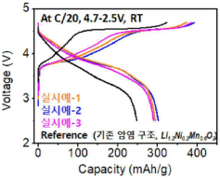
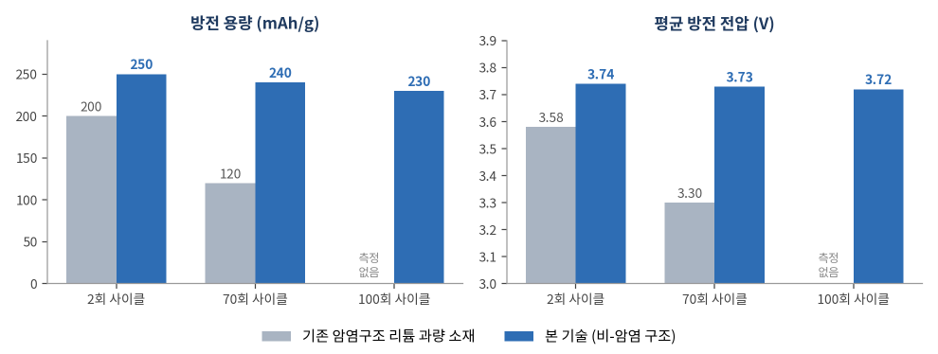
Advantages of the Technology Its greatest strength is that it maintains high voltage and capacity even after repeated charge-discharge cycles. In the first cycle, the material showed a discharge capacity of around 300mAh/g, storing more energy than conventional lithium-rich materials (about 250mAh/g). The difference in durability is even more pronounced. After 70 cycles, the conventional material's capacity dropped from 200mAh/g to 120mAh/g and the average voltage from 3.58V to 3.30V, whereas the material of this technology remained nearly unchanged, with capacity at 240mAh/g (from 250mAh/g) and average voltage at 3.73V (from 3.74V). Even after 100 cycles, it maintained 230mAh/g and 3.72V, with no signs of structural change.
This approach differs from existing solutions. While surface coating or element addition protects the exterior of an already formed material, this technology redesigns the very sites where lithium enters, reducing the cause of structural change. The patent states that a lithium-rich material with this amount of lithium in tetrahedral sites has not been previously reported. Furthermore, because it can be produced using a cobalt-free nickel-manganese composition and the widely used solid-state synthesis method, it offers both performance improvements and cost competitiveness.
Applications The most direct application is the lithium-rich cathode market, where commercialization competition has already begun. Cathode and battery companies can apply this to design next-generation cathodes with reduced voltage decay, with primary demand coming from electric trucks, large SUVs, entry-level EVs, and energy storage systems (ESS). Since the same technology is patented in the US, it is also advantageous for exploring commercialization with companies that have North American production bases.
Reducing the voltage decay that has hindered the commercialization of lithium-rich cathodes through structural design opens the door to achieving high energy density while lowering reliance on expensive nickel and cobalt. This is expected to alleviate battery costs and supply chain burdens, contributing to both increased driving range and price competitiveness for electric vehicles.
Patent Listing IBL-26-1962
Inventors: Professor Byoungwoo Kang and Jeonghwa Lee, Department of Materials Science and Engineering, Pohang University of Science and Technology (POSTECH)



