
The robot controls its center of gravity by shifting the point of application of rope tension to a moving unit on an upper LM guide, allowing it to lift specific wheels away from the wall to clear protruding window frames without stopping the cleaning process.
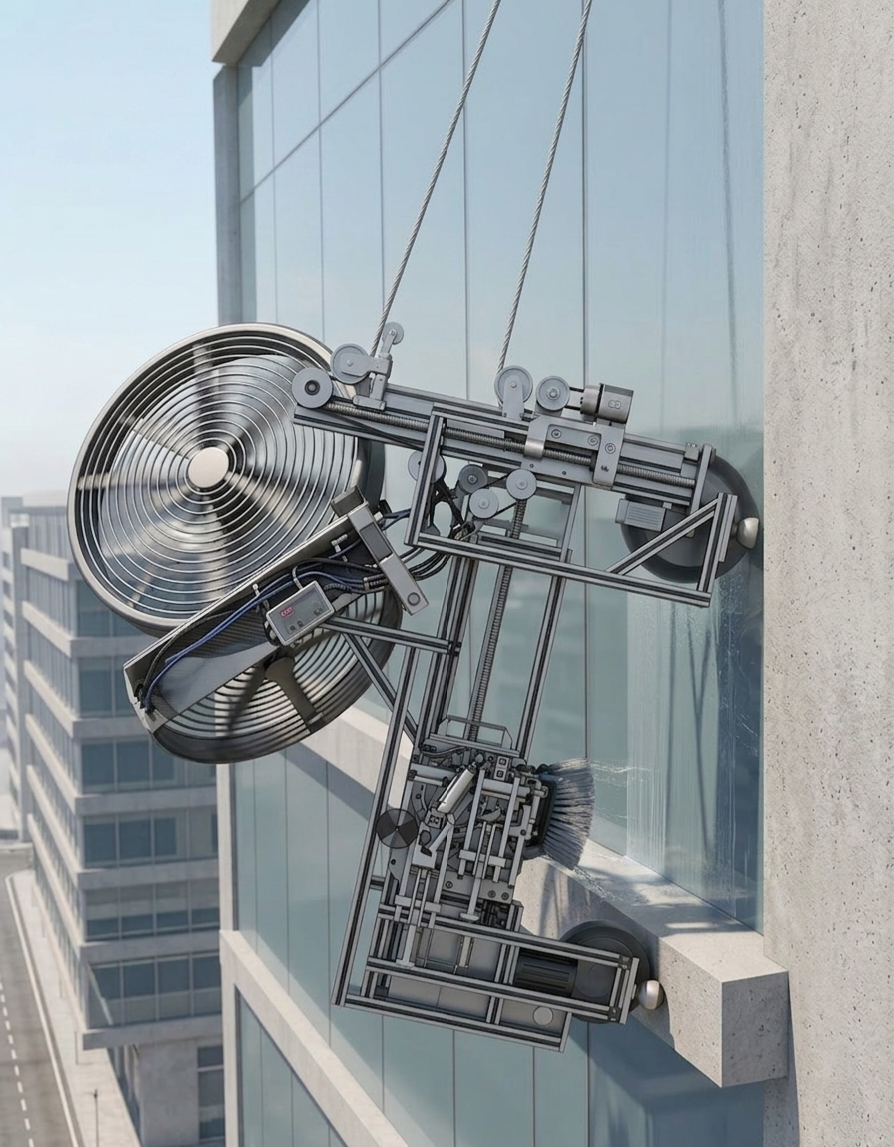
Background and Necessity of the Invention
As city skylines reach higher, the appearance of a building is defined by its facade, particularly its glass curtain walls. Because these glass surfaces become covered in dust, exhaust, and rainwater streaks over time, regular cleaning is essential. However, cleaning at heights of dozens of stories remains a task largely performed by humans. The most common method involves workers suspended by ropes or gondolas lowered from the roof, which is considered a high-risk job due to the constant danger of falling from such heights.
Compounded by an aging workforce, labor shortages, and increasingly stringent industrial safety regulations, the demand for robots to replace humans in facade cleaning is growing rapidly. Market research firms also project that the market for automated building facade cleaning and maintenance will continue to grow, driven by the rise in high-rise buildings and stricter safety standards. The challenge lies in the fact that keeping a robot securely attached to a vertical glass wall while moving it as desired is not as simple as it seems.
There are several ways to keep a robot pressed against a wall: vacuum suction, magnetic attachment for steel structures, pre-installed rails, and using propeller thrust to press the robot against the surface. However, the real difficulty lies elsewhere. Building facades are rarely perfectly smooth surfaces. They are filled with large and small protrusions, such as window frames, mullions, decorative bands between floors, and panel joints. A vertical cleaning robot must navigate these obstacles without losing contact with the wall, which is where existing methods hit their limits.
In practice, wheel-based robots require wheels larger than the obstacles themselves to climb over them, while robots relying solely on propellers face complex attitude control and poor energy efficiency. Legged robots can clear obstacles but are slow and inefficient. Ultimately, a new approach was needed—one that could smoothly clear protruding obstacles without the need for oversized wheels, complex active control, or slow, cumbersome legs, all while maintaining continuous cleaning.
Technical Principles and Implementation Methods
This invention starts with the idea of the robot tilting its body slightly to clear obstacles. The robot is suspended by two ropes lowered from the roof, and the thrust generated by large ducted propellers presses the robot body against the glass wall. As a result, the wheels attached to the body roll while remaining in close contact with the surface, allowing the cleaning mechanism in the center to scrub the wall. Like a magnet held to a wall by the force of air, the robot moves stably across the glass surface.
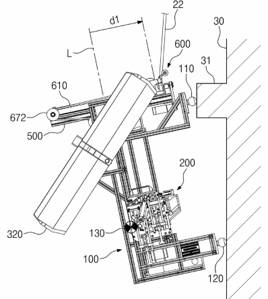
The key lies at the top of the robot body. An LM guide of a predetermined length is coupled to the body, and a moving unit driven by a ball screw travels back and forth along it. The ropes are not tied directly to the body but are connected to this moving unit. In other words, the point where the rope tension actually pulls the robot—the "tension application point"—can be shifted left or right along the guide.
It is easy to understand by imagining a tray being held up by a single string. If you hold the string directly above the center of gravity, the tray stays level, but if you move the holding point to one edge, that side lifts up. This robot works the same way. By shifting the rope's application point away from the robot's center of gravity, the resulting force imbalance causes the robot to tilt, lifting one of the wheels off the wall. Instead of applying constant, large external forces, the robot controls its posture simply by changing "where" it receives the force from the suspended ropes.
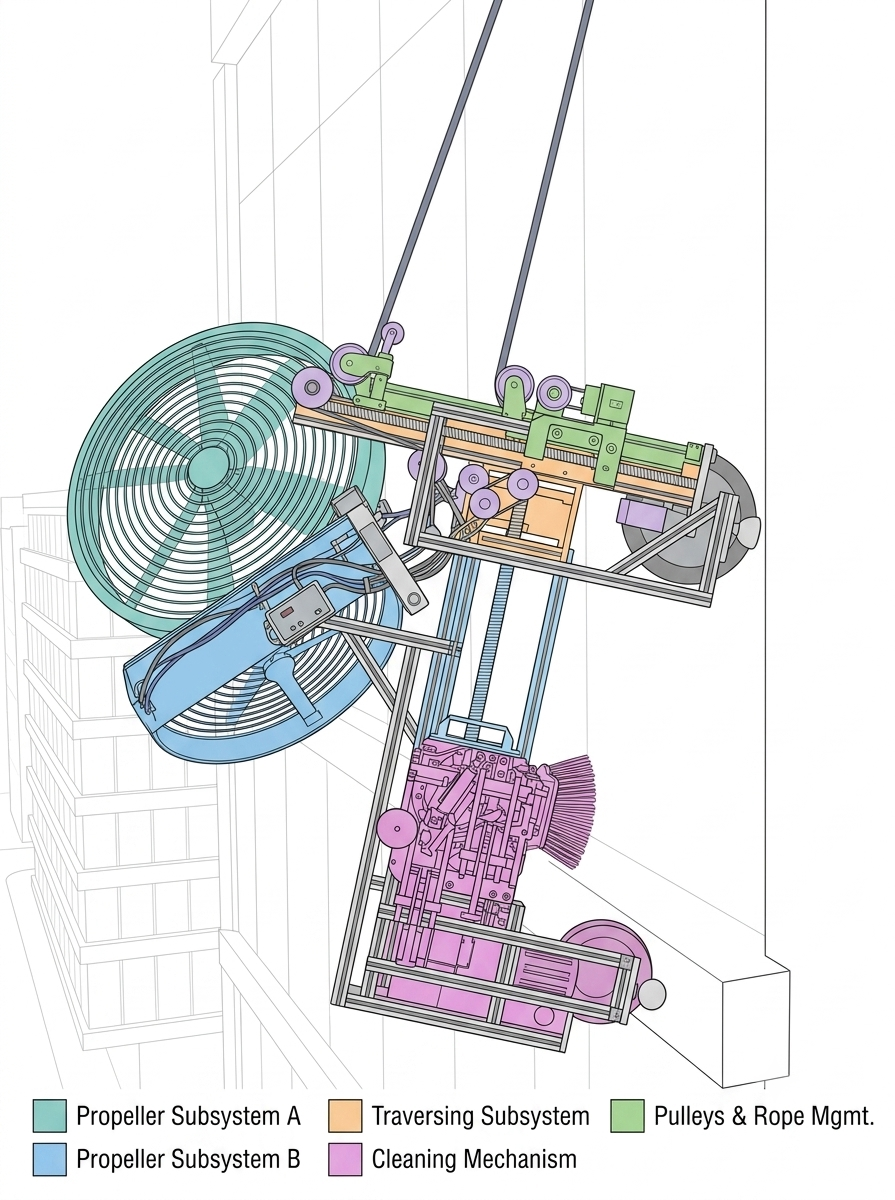
This principle truly shines when the robot encounters an obstacle. When the robot's obstacle detection sensor identifies a protruding window frame ahead, the control unit moves the moving unit to shift the tension application point according to the height of the obstacle. The robot then tilts as needed, causing the front wheel to lift slightly off the wall to clear the frame, while the rear wheel maintains balance by staying in contact with the wall. Once the obstacle is cleared, the application point is returned to its original position, bringing the wheel back against the wall to continue cleaning. Without the need for massive wheels or complex control systems, the robot clears window frames simply by shifting the point where it receives the rope tension.
Advantages and Expected Effects
Advantages of the Technology The greatest strength lies in the remarkably simple way it overcomes obstacles. Instead of using oversized wheels, constantly controlling propellers for precise positioning, or relying on slow-moving legs, the robot simply shifts the rope's tension point to adjust its center of gravity. By using proven mechanical components like LM guides and ball screws to move the shifting unit, it can selectively lift specific wheels, allowing for continuous and stable cleaning even over building protrusions like window frames or mullions.
This approach directly bypasses the limitations of existing facade cleaning robots. Wheeled robots require wheels larger than the obstacles themselves, propeller-based robots suffer from complex control and low energy efficiency, and legged robots are slow and inefficient. This technology separates the tasks of "sticking to the wall" (propeller thrust) and "overcoming obstacles" (center of gravity control via tension points), keeping each function simple. The result is a structure that achieves both high performance and simplicity, capable of navigating the irregularities of actual building facades without needing massive wheels or complex control systems.
Applications The most direct application is cleaning the glass facades of high-rise buildings. It can be used for all types of high-altitude exterior work that is dangerous or difficult for humans to access, such as on skyscrapers, hotels, hospitals, and residential complexes. Beyond cleaning, the scope of application extends to exterior painting and facade inspection or diagnostic tasks that require continuous movement across surfaces with protrusions. The ability to continue working without stopping at obstacles like window frames is particularly valuable for these missions.
Above all, by having robots perform dangerous high-altitude tasks that previously required humans to rely on ropes or gondolas, the risk of falls can be fundamentally reduced. Work efficiency is also increased as the robot performs continuous cleaning without needing to stop or detour for every obstacle. Furthermore, because it is implemented using widely available components like LM guides and ball screws, production and maintenance costs are kept low. This is expected to accelerate the automation of the building maintenance industry, which faces the dual challenges of labor shortages and strict safety regulations.
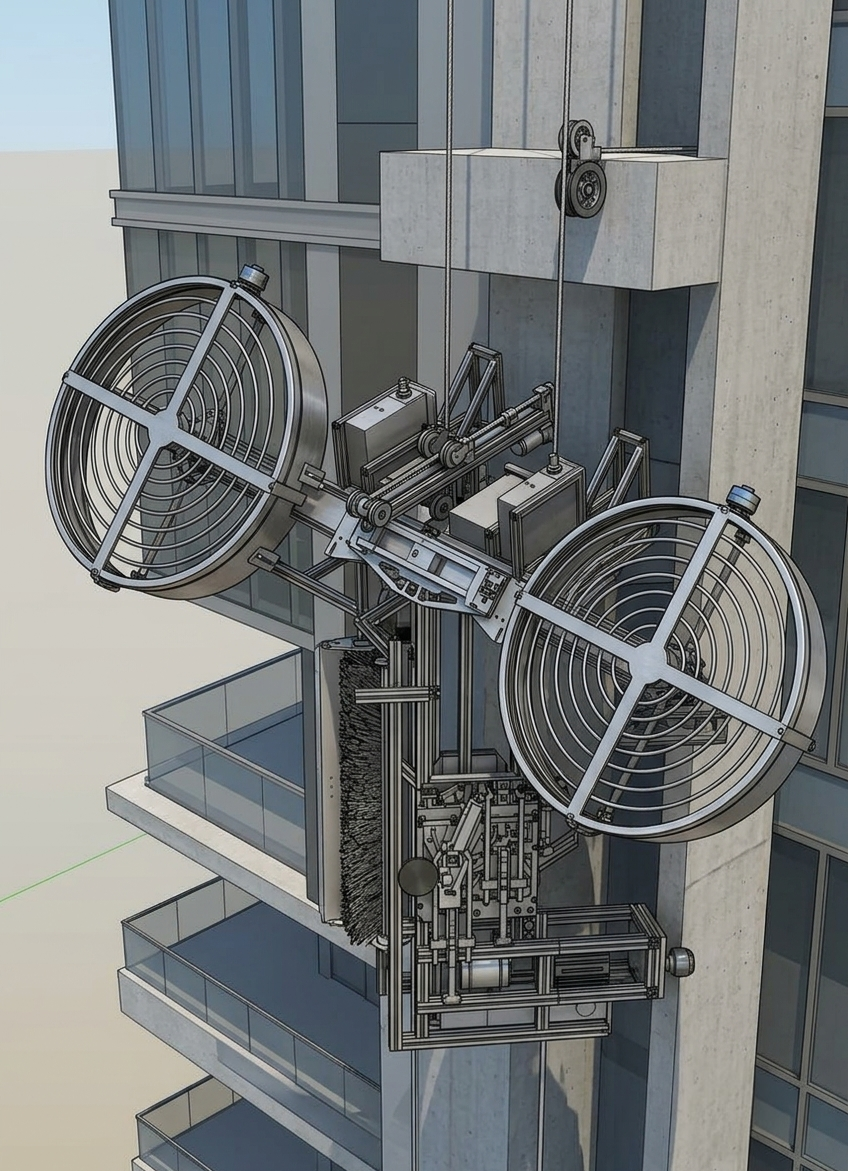
Patent Listing IBL-26-1374
Inventors Professor. Seo Tae-won, Lee Kyung-wook, Chae Ho-byeong, Moon Ye-cheol, Choi Myeong-jin, Ahn Sa-hoon, Kim Kyung-min, Department of Mechanical Engineering, Hanyang University