
A flame-retardant crystalline organic solid electrolyte that maintains a solid state even above 60°C through a co-crystal structure formed by a sulfone-based solvent and an alkali metal salt, and reduces interfacial resistance with electrodes via a melt-casting process.

Background and Necessity of the Invention
As the use of electric vehicles and energy storage systems grows rapidly, battery safety has become as critical a competitive factor as performance. Current lithium-ion batteries use flammable organic liquid electrolytes, posing risks of leakage and fire due to external impact or overheating. All-solid-state batteries, which replace liquid electrolytes with solid ones, are considered a fundamental solution to these issues. Market research firms project that the global all-solid-state battery market will grow at an average annual rate of nearly 40% through 2032, and the three major domestic battery manufacturers are accelerating development and pilot line construction with the goal of commercialization between 2027 and 2030.
However, solid electrolytes still face many challenges. Sulfide-based, oxide-based, and polymer-based solid electrolytes proposed to date suffer from issues such as poor ion mobility, narrow electrochemical stability windows, or difficulty adhering to electrode surfaces. In particular, because solids cannot penetrate gaps like liquids, they lack sufficient contact area with electrode particles, and this interfacial resistance becomes a primary cause of degraded battery performance.
Organic solid electrolytes made from organic molecules have been proposed as an alternative, but the representative material, succinonitrile, has a melting point of only 50°C or lower. Since the internal temperature of a battery can reach nearly 60°C during operation, the electrolyte may melt, losing its advantages as a solid.
Therefore, there was a need for a new solid electrolyte that remains a hard solid at battery operating temperatures while allowing ions to move freely, filling even the microscopic gaps in electrodes to reduce interfacial resistance, and resisting fire.
Technical Principles and Implementation Methods
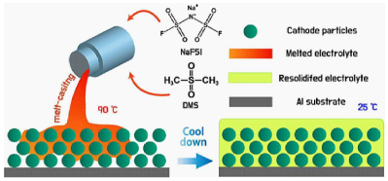
The electrolyte of the present invention can be compared to a candle or chocolate. When melted, it becomes a liquid that flows into every corner of a mold, and when cooled, it hardens into that shape. This property is used to melt the electrolyte, pour it into the electrode, and let it solidify to create a solid-state battery.
The material consists of two components. One is a sulfone-based solvent, typically dimethyl sulfone, which serves as the stage for ion movement. Dimethyl sulfone is inexpensive, non-toxic, and does not decompose easily even at high voltages. The other is a bis(fluorosulfonyl)imide alkali metal salt that provides lithium or sodium ions. When the two substances are mixed and heated, they melt together at a lower temperature than either component alone, and upon cooling, they form a "co-crystal" in which the two molecules, which share similar structures, are regularly arranged within a single crystal. Thanks to this regular structure, this crystalline organic electrolyte remains solid while allowing ions to move efficiently.
The key lies in the precise design of the melting point. By adjusting the molar ratio of the metal salt to the solvent within the range of 1:9 to 4:6, the melting point is set between 50°C and 170°C. The lower limit is set higher than the battery's maximum operating temperature (60°C) to ensure it remains solid during use, while the upper limit is set lower than the melting point of the polymer binder in the electrode (170°C) to allow it to be melted and poured without damaging the electrode. In fact, the melting point of the composition for lithium batteries was 65°C, which is higher than that of the comparative electrolyte (58°C).
When this electrolyte is melted and poured onto the cathode, the liquid electrolyte penetrates the microscopic gaps between the active material particles. Upon cooling to room temperature, the electrolyte solidifies again while coating the particles. Unlike methods that press solids together, the electrode and electrolyte are perfectly interlocked from the start, significantly reducing interfacial resistance. Adding a small amount (0.5–5%) of a polymer or fluorine-based additive further lowers the interfacial resistance with metal electrodes, resulting in an interfacial resistance with lithium metal that is only half that of the comparative electrolyte.
This electrolyte can be used for both lithium and sodium batteries simply by changing the metal salt. The sodium composition showed higher ionic conductivity than existing oxide-based or polymer-based solid electrolytes in the 5–60°C range.
Advantages and Expected Effects of the Technology
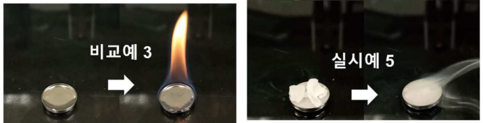
Advantages of the Technology Its greatest strength is its long-term stability under high-temperature conditions. In a 45°C operating environment where internal temperatures reach nearly 60°C, a lithium metal/nickel-based cathode battery using this electrolyte maintained a coulombic efficiency of over 99.8% for 150 charge-discharge cycles, whereas a comparative electrolyte with a melting point below 60°C saw a sharp drop in capacity and efficiency around the 90th cycle. In sodium batteries, the capacity retention rate after 200 cycles was 91.1% at room temperature, significantly outperforming existing liquid electrolytes (60.3%), and at 60°C, it was 50.3%, nearly three times that of the liquid electrolyte (17.2%). Its oxidative stability at high voltages was also higher than that of conventional carbonate-based liquid electrolytes, and it did not ignite even when directly exposed to a torch flame.
This approach differs from existing solid electrolytes. Previous materials were limited by the need to press non-melting solids onto electrodes or by low melting points that caused them to melt during operation. This technology matches the melting point between the operating temperature and the electrode processing temperature, allowing it to be handled like a liquid during manufacturing and function as a solid during use. The patent states that there are no prior reports of applying a crystalline organic electrolyte to melt casting and analyzing its actual battery characteristics. Another strength is that it uses inexpensive, non-toxic dimethyl sulfone as the main ingredient and allows for a process similar to existing liquid electrolyte injection methods.
Applications Primary applications include vehicle batteries and energy storage systems operated in high-temperature environments, next-generation solid-state batteries using lithium or sodium metal, and industrial high-temperature power supplies. In particular, since the same principle can be applied to sodium batteries, which are more resource-abundant than lithium, it is well-suited for large-capacity energy storage fields where cost is critical. Material companies preparing for the solid electrolyte business or battery companies developing all-solid-state battery processes should consider adopting this technology, which is also patented in the United States.
By using a simple melt-casting process to bring a flame-retardant solid electrolyte into close contact with electrodes, both the interfacial issues and manufacturing difficulties—the biggest obstacles to the commercialization of solid-state batteries—can be reduced. This is expected to enhance the safety of electric vehicles and energy storage systems by reducing fire risks and cooling burdens, while also contributing to lowering reliance on lithium through the expansion of sodium batteries.
Patent Listing IBL-26-2125
Inventors: Professor Ho-Chun Lee, Seok-Beom Kang, and Chang-Ui Yang, Department of Energy Science and Engineering, DGIST



